Family & Other Stories
Family Stories - Paul Quincey
Henry Quincey
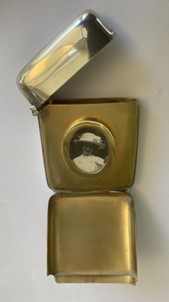
My grandfather Henry married Gertrude in October 1914, aged 27. He volunteered sometime in 1915, serving in the Royal Warwickshire Regiment as a private soldier. The picture shows him with their first child, born in October 1915. Gertrude's father was a jeweller, who presumably provided the silver match box for Henry to take to the front.
He fought at the Somme, then in the Dolomites, and later back in Flanders. He was wounded twice, firstly shot through the leg, and later receiving a shrapnel wound to the back of his hand. He was in the massive Netley Hospital near Southampton when the war ended. My father was born in January 1919.
Although relatively unscathed physically, Henry took several years to adjust to civilian life, and during that time was supported to some extent by his father-in-law. It is ironic that his father-in-law was a native of Germany, born near Leipzig, who had been naturalized as British in 1886. It is possible that Henry had been fighting against some of his wife's cousins.
He ran his own chemist's shop in Bournemouth for many years, and died in 1969 aged 82.
Leigh Charlton
Leigh was an adopted orphan who lived as a foster brother to my grandmother, Vera Aplin, near Brisbane in Australia. In 1916 he was aged 21; Vera was 13.
Leigh had enlisted in October 1915. He left Brisbane for Sydney on 30th March 1916, continuing to Alexandria, where he joined the 25th Battalion with the 11th Reinforcements, and from there to Marseilles, where he arrived on 18th May.
From Vera's diary we know that on 12th July she received birthday gifts from Leigh of a packet of coloured views of Cairo, a nice old mosaic brooch, and a soldier's biscuit, on 7th August two postcards and a nice silk handkerchief, and two "fancy" postcards on 25th August.
Leigh reached the trenches at Pozières (part of the Battle of the Somme) on 1st August. On 20th September the family received a telegram to say that Leigh had been missing since 5th August. His death on that date was only confirmed in a letter in April 1917. His friends had reported that Leigh had been killed in No Man's Land by a shell, and when they reached him the next day they buried him in a shell hole close by.
We can gain some insight into feelings at the time from letters written by Vera's aunt Margaret Hawkes to the Australian Red Cross Society: "Death in action is infinitely better than being starved and ill-treated as prisoner of these brutal Germans." And a little later: "I am so thankful to hear that the dear lad was decently buried, and by his own countrymen. I have tried not to think of the horrible desecration his body might have received from German hands."