Personal Reflections
Andrew Warrener
What a fantastic three day trip we have just had. I guess we all had varied reasons to have been on such a tour, personally I felt it was something that should be done, as I had never before paid homage to those that had given their lives in the Great War for the sake of King and Country. However it was so much more. We had perhaps the best guides for such a trip, their knowledge and enthusiasm throughout kept me captivated. It was wonderful to hear the poems and stories that other members of the tour shared. Also the light hearted personal experiences and banter former pupils had about Tonbridge School (including beatings) during the less important sections of the coach trip, leading to a relaxed and fun atmosphere.
Before going on the trip, I had asked a few OT's that I still see if they wanted to come. For many reasons none of them could. However the group consisted of Tonbridgians from all ages and houses. What a wonderful group, people seemed very at ease with each other and when we said our goodbyes back at Tonbridge, it felt like leaving a party: I suspect many of us may now keep in contact.
The tour was very emotional and, despite being nearly one hundred and ten years since it's start, still feels relevant and personal today, unlike, say, the Boer War. I am sure most of us knew stories or knew the unbelievable loss of life. But the tour brought home the conditions that those men lived and fought in, together with a Tonbridge perspective by visiting OT graves. To include the graves of German soldiers also helped put the war in perspective. Unfortunately, this was not the war to end all wars as some of the soldiers thought, but if a soldier from that war were to come alive now, I am sure he would feel that England has a more equal society and that generally Western Europe feels safe and better off within itself. Maybe if more people know about and go on the Western Front Walk that soldier and Gillespie will feel it more worthwhile.
This has been an educational and emotional tour, with even the driver John becoming tearful. There are so many details that one has read or heard about that will remain with me, from the craters left by those mines, or the terrible weapons used to kill or maim to what must have seemed the unreal world of Talbot House. However something I will never forget was a picture of some soldiers taking cover and smiling at the camera from water filled shell craters with a bit of tarpaulin as cover from the rain and under them to try to stop the water coming through from the ground. The picture was taken in Flanders, their trenches full of water. What did those men think of their lot? One small surprising picture to me was of a small dog in a German trench being used as a rat catcher; that must have been a good friend and comfort to those soldiers.
My thanks to Anthony and David for leading the tour and all those on the tour making it such an unforgettable experience
Peter Grimsditch
The WFT has been great so far, everyone very kind and helpful, Peter H. In particular; the group has developed its own form of affectionate, convivial and garrulous dynamics and cohesion (I have only ever heard the sort of (most unEnglish) hubbub unleashed here around the hotel dining table in the cafes around the plaza mayor in my wife's village in Extremadura!
Anthony and David have been excellent, good natured, guides full of fascinating information, as have the contributions and anecdotes of other members of the group; it is my turn this evening. John, our driver from Edinburgh has also been very solicitous of his flock
Mark Oxley
Who would expect that a coach trip with a bunch of people one never knew from 'school' to see some graves in France and Belgium could be so uplifting?
I was struck by the 'family' nature of our short journey. How, unwittingly, our lives and those of our forebears are inter-connected. Andrew's grandfather near Flers injured from his artillery position, seeing the first tanks pass, only a short distance from Robert's relation fighting on the line. Close, another Andrew showed where his grandfather attacked up a hill. Tonbridgians, with VC or otherwise, buried nearby. Was it at least four of us from our small group who had relatives injured at the first day of the Somme, including my grandfather?

My grandfather, Ronald William Naylor, was first at the Ypres salient, then the Somme, along with the others.
Born in 1897, he was only 18 in 1915 when he signed up. He did not join as an officer, but became one in 1918.

The amazing 15th Hampshire regiment War Diary, meticulously written in pencil daily, records the names of Dickebusch, Voorzemele and St Eloi at the start of 1917. These places on the then front, now seen on Apple Maps, are only a mile or so south of where we were standing on Vauban's magnificent fortifications of Leper/Ypres built by Louis XIV.
On the 14 March 1917 at Voorzemele 'A Patrol consisting of 2nd Lieut. Fowler, Cpl. Stuart and Ptes. Dicks, Nunehane, Rappie, Naylor, Kelly, Rolland, Harris, Cross and LCpl. Copping left our trenches at 8pm for the purpose of placing two Bangalore torpedoes in the enemy's wire which was successfully carried out. Owing to one of the fuses breaking only one torpedo was fired, which was done at 10.30. The whole party returned safely. The object of this work being to distract the attention of the enemy, during a raid being made by the East Surreys at the same time in which the Artillery here cooperated'.
Other 'family' were nearby: James and Nick's grandfather was in the East Surreys; who knows how that attack went.
We were all impressed at the availability and accessibility of records from over 100 years ago. And their detail. In our case, medical records, papers from my grandfather applying to be an officer and the war diaries. This written history preserved as evidence of our bond, of many other stories of our collective grandfathers.
Seldon and Walsh book's Appendix refers to 207 Public Schools. You can imagine another 206 school trips with equal numbers of tales. And then everyone else, like the other group in the hotel, 8 chaps from Stoke. They with us and another 200 odd people on a Wednesday evening in April attended the Service of Remembrance at the Menin Gate, held daily for 100 years. A group of Australian boys from a school 100 miles north of Melbourne movingly laying a wreath, and bringing to this place memories of their great grandparents. We had seen rows of Australian dead only hours earlier.
Given the length of the front, something you appreciate when you are on the ground, and the relatively concentrated hot spots, the interlinked nature of those times is, really, inevitable; but that is what makes it so fascinating.
Driving in to Ypres for the first time with the diary of Brigadier General Roger Tempest and his sister's trip in October 1919, written testament, drawings and photographs of a town destroyed, very moving as it helped you cast your mind back directly to the time of these tragic events.
Our experience was greatly enhanced by readings of the war poets, from letters and reminiscences from our leaders, fellow OTs/their wives and partners. Most moving, a rendition of 'We Will Remember Them' before the 50,000 dead at Tyne Cot.
We are the children of the survivors; the living. Most of our grandfathers survived which is why we could be here over 110 years later to remember. But as Anthony said, for how much longer?
At our last lunch we chatted about Darwin and the Church's position today on Evolution. Breaking the social code, I asked Jane L, about the Church's current stance on the subject. Like many others, despite hours of School Chapel, I see myself as a 'cultural Anglican'. I struggle with the idea of Jesus' physical resurrection (seemingly entry level for proper believers). And seeing the self-sacrifices from this ghastly war, from gentle, kind and civilised people, as epitomised by the wonderful letter read out by Robert L from his great uncle, I find the Easter story not so exceptional but perhaps the norm for people who die daily for what they believe.
On collective memory, one goes through life thinking that one's own recollections of school are perhaps deeply unique and personal. It was fascinating chatting with ex-cons and sharing collective memories, some 50 years later, of places and people. Memories too of our parents, of their prep schools and a shared love of good things such as fine tweed and shoes, Chateau Talbot and the Old Widow.
Without wishing to fetishize the EM Forster quote from Howards End 'Only connect! That was the whole of her sermon. Only connect the prose and the passion, and both will be exalted, and human love will be seen at its height. Live in fragments no longer', our short odyssey illustrates the commonality of our experience as human beings at a personal, group, regional, national and international level. If you search, God (whoever s/he is) truly gives his increase.
Giles Craven
I was deeply depressed by the catalogue of missteps on July 1st 1916, the first day of the Somme. The fate of the Newfoundlanders and the Accrington pals was difficult to read/listen to. The Newfoundland Park was both moving and instructive in explaining what went wrong for them. The war meant many lean years for the island which had lost so many young men. Boys from my home town Sheffield had a terrible time as well.
The rewards given to General Sir Henry Rawlinson of the 4th Army were astonishing; a baronetcy; a large sum of public money and the job of c in c in India; all for a job not well done.
Beth Craven
I did not speak on the trip, feeling a bit of a fraud given the moving histories from other people's families. One of my grandfathers was too young to fight; the other was drafted on 22 December 1917 and never got further than an army base in South Carolina.
We studied WW1 in the States and I vividly remember reading Barbara Tuchman's The Guns of August and Vera Brittain's Testament of Youth as a 15 year old in California. American Civil War monuments and memories still overtook people's emotions during and after WW1. These wars certainly led to the serious isolationist feeling in the US after WW1.
On a beautiful May day in 2009 I was walking through Dulwich and passed my neighbour Margaret's* house. There were three Army officers at her front door. Five minutes later I met Margaret in the street. We smiled and said hello to each other as she walked home. Those officers were waiting to tell her that her son had been seriously wounded in Afghanistan. I'll never forget the contrast of that spring day, her smile greeting me and the terrible news she heard minutes later. Her son died from a shoulder wound, unnecessarily, because the radio equipment failed and no helicopter help came in time.
Three years later my own son, another young, blond lieutenant, went to Afghanistan. The toll his six month tour took on his parents and sisters was huge. I cannot imagine spending four plus years living in constant fear of those officers (or the telegraph boy) waiting at my front door.
The OT tour exposed poignantly the extreme living and fighting conditions around the Somme and Ypres. Such a small area, so much destruction and so many lives of those at home turned inside out with worry and grief both during and for long after the war.
* Margaret Evison wrote A Soldier's Death: A Mother's Story and set up the Mark Evison Foundation to encourage young people to challenge themselves.
Odile Grieve
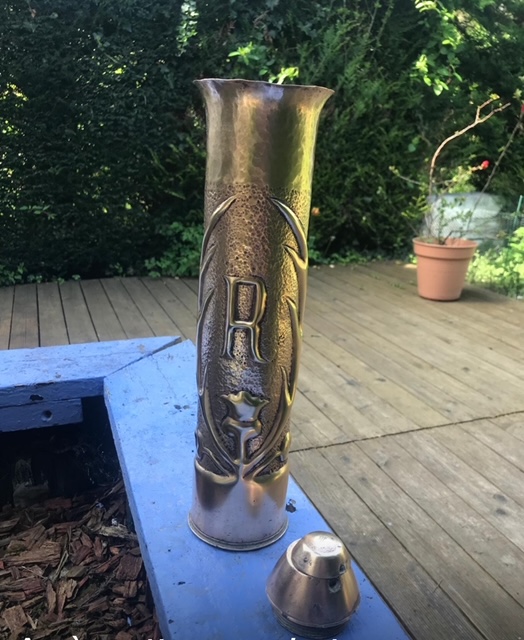
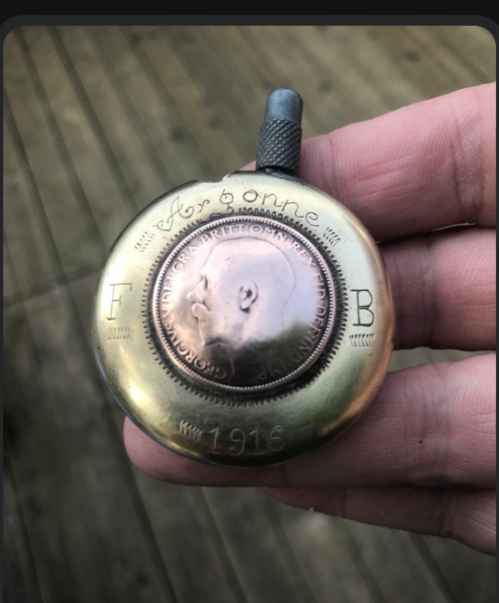
A lot of people during the tour asked how French people remembered the first world war and comemorated it. Beside the traditional homage on 11/11 a lot of French families collected decorated shells. These artefacts were to be found in people's houses and the one below was on the mantle piece of my grandparents' house along with a portrait of Petain (the hero of Verdun) hidden in the attic.
Clem Somerset
Difficult to gather thoughts after such a varied, emotional and interesting tour, but I think I was most struck by the openness and mud even with trenches and shell holes in the uncropped fields around. It gave some (very little) idea of what conditions may have been like with that type of soil and landscape.
The Menin Gate ceremony was very moving and extraordinary to think that this same ceremony has been repeated every night since 1928 (apart from during WW2)
I found the prison cell and execution block at Pops very difficult to get out of my head, and attach a photo taken of the square from the prison cell window.
I attach some pictures from the trip, most of which will probably be covered, but I liked the photo I took in the Tyne Cot museum of the files of soldiers re-burying the exhumed dead at Tyne Cot. What a terrible job that must have been.
Gerald & Virginia Corbett
Thank you all for such an amazing couple of days on our Western front tour last week.
I came along with great trepidation : Much apprehension of claustrophobia in the bus and tunnel and anticipating guffawing old Tonbridgians. (Rather led by my husband ?!)
Since returning I've read Anthony's wonderful Western Front Way/Path of Peace (another reason to return) and I think of those Gillespie brothers who resonate a little with my pairs of above brothers.
Our daughter said (in awe) David Walsh wrote so many of the history books she teaches with.
A truly an eye opening, mind blowing couple of days, with amazing tour leaders. It was wonderful to be with everyone, and all those beating stories of course ..
Love and thanks to all
Brian Gibson
I have never been on a tour of such high calibre leadership, being Anthony Seldon and David Walsh, with the knowledge of the Somme and Ypres Salient straight off the top of their heads, delivered in manners that were understood and appreciated by all. Our concentration on the serious, and the lighthearted, was unavoidable at every time of detail, both on and off the coach, and the information provided much education for us and led to appropriate and understandable emotion.
Thank you Anthony and David.
Thank you also Ant for your comment regarding the loss of your good school friend Rob, my brother, who died at too young an age a year ago, who would otherwise have joined us. Our meeting made a circle as you were unable to make his funeral.
In addition, what a wonderful, sociable experience the tour was, and thanks to all including driver, everyone who told us wartime stories, read poems or 'joked' about beatings before they became an offence!!
Peter Hamilton
The commentaries of Anthony Seldon and David Walsh on the coach were an enthralling part of our journey, not only informing us and entertaining us but drawing us together.
For example, at the end of the first afternoon as we approached Ypres/Leper, our destination, signalled afar off by the towers of the Cathedral and Cloth Hall, Anthony made us welcome with his words of introduction. Ypres was not just one more 1st World War site, but was special on account of its setting - surrounded by water and hills on 3 sides and close to the Channel - , because of the complete rebuilding it underwent with reparation funds, because of its association with the British and, most strikingly, because of the love he confided he has for the town. Arrival did not disappoint the expectations which he aroused.
The following afternoon before the closing lunch at the Hostellerie Kemmelberg Anthony delivered a few valedictory words of appreciation and advice to us. He urged us not to retire and become inactive at the end of our careers but, on the foundation of the trip, to go on setting goals to achieve things not yet achieved. In short, make the best of life! This seemed like a particularly apposite message given the tragic cutting-short of so many lives on the Western Front.
Alasdair Paterson
Langemark German Cemetery
There was a strange congruence about this visit. I had bought a blue poppy at the cloth hall museum with the view to placing this on a German conscript's grave as I feel their conscripts were as much victims of circumstance as our own conscripts. Instead I was able to place at the Kameraden Grab (Comrades Grave) with the four mourning figures sculpture by Emil Krieger which marks the mass grave of 24, 917 German soldiers.
I also spread some poppy seeds here. The seeds were from de Havilland Memories with the name Florrie Warrener included on the pack, printed entirely in German. On mentioning the above details to Andrew Warrener, it turns out that Florrie is his daughter whose husband is German. I was pleased that everything had coincided so satisfactorily.

,_Spanbroekmolen,_Nr._Ypres.JPG "click to enlarge")