Family & Other Stories
Family & Other Stories - Peter Grimsditch
Frank Grimsditch, my great-uncle
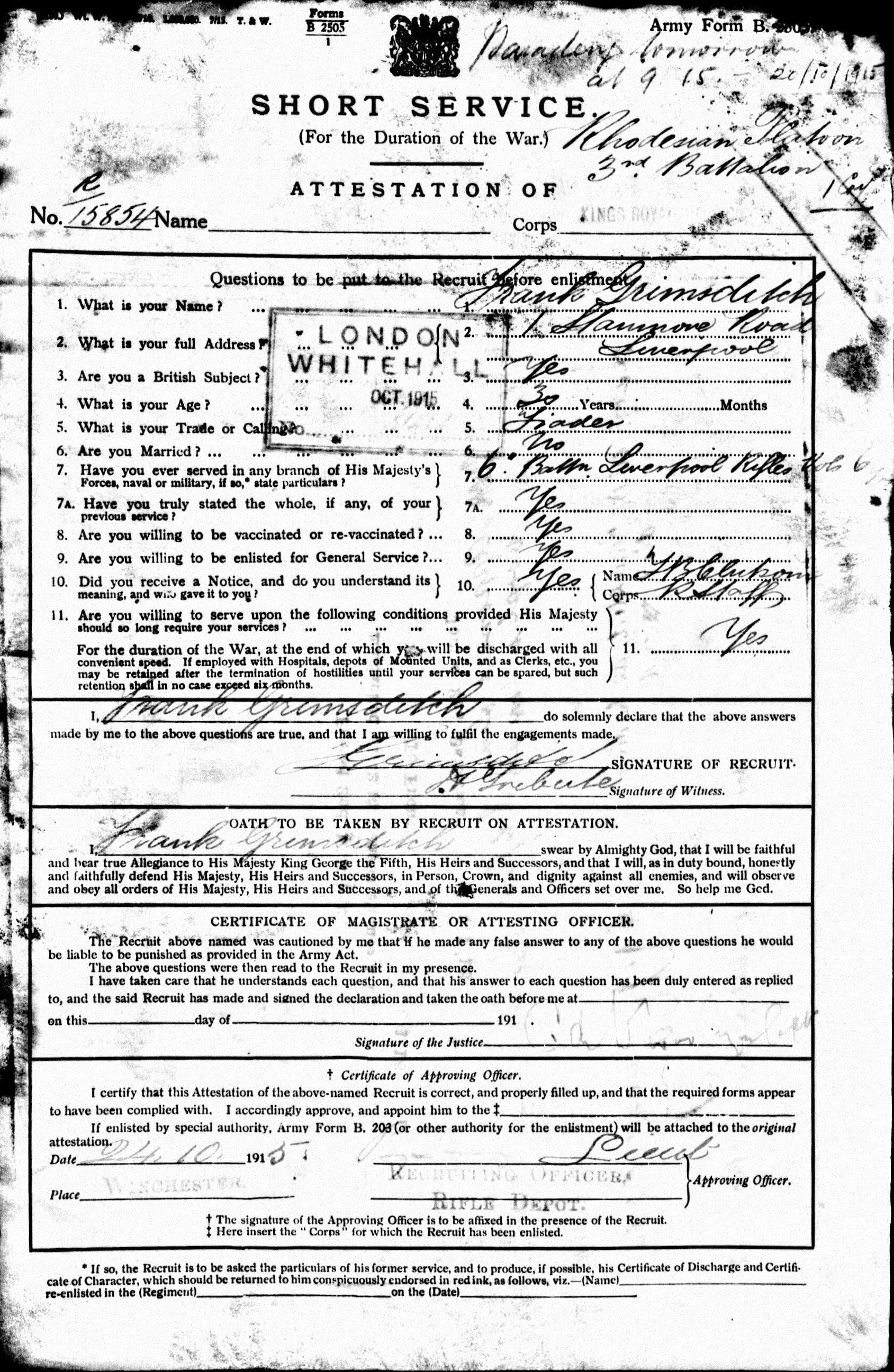
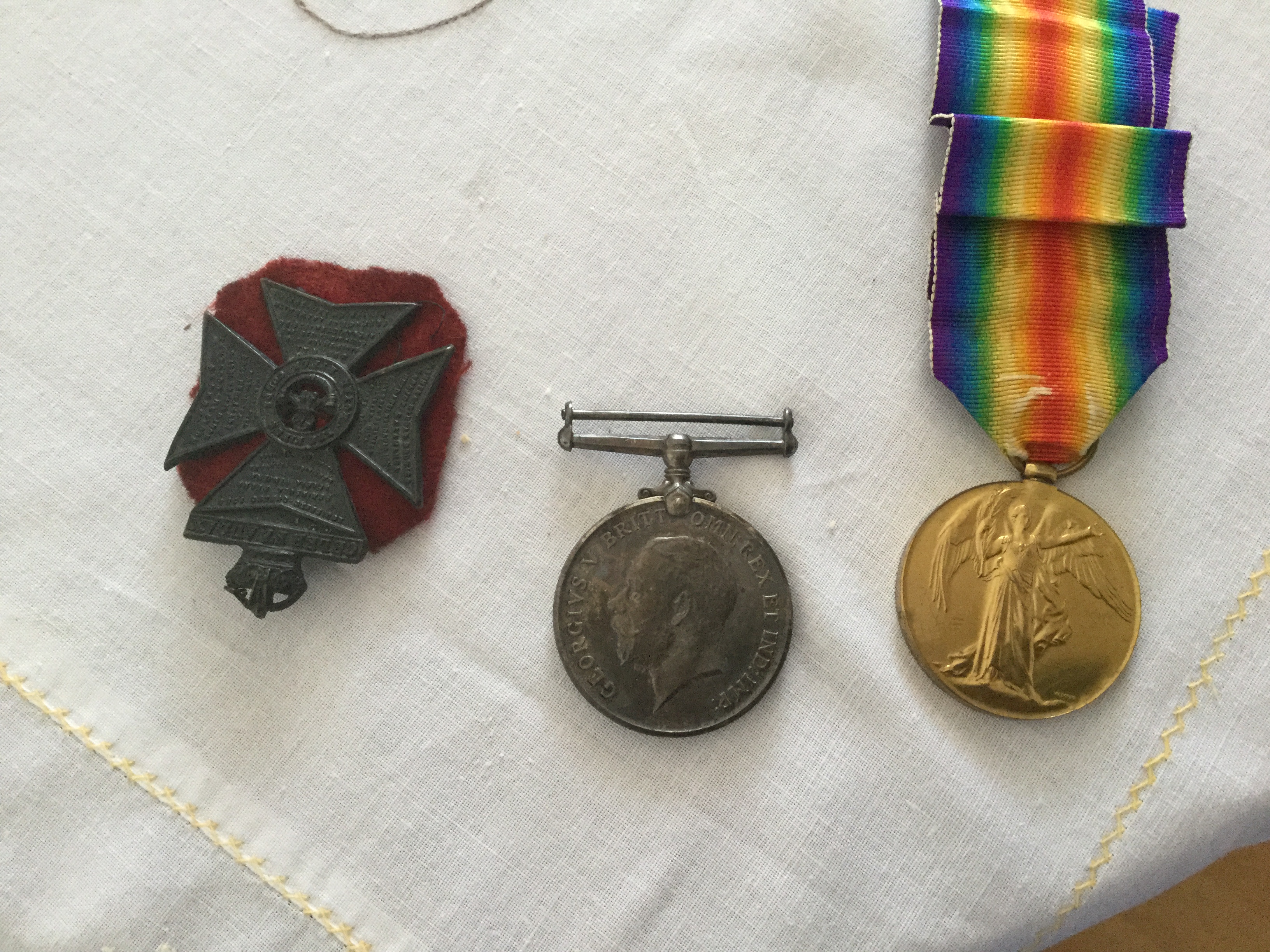
My great-uncle, Frank Grimsditch, was born in Liverpool around 1890. He came from a working-class, seafaring, Liverpool family, and on enlisting, he described his profession "trader" (and so not exempt from conscription). He answered the call and in 1914 volunteered, joining a "Pals Battalion" in Liverpool, which was subsequently incorporated into the King's Royal Rifles, as its first batallion.
For Frank, however, the war was of short duration, as he died of wounds on the opening day of the battle of the Somme, 1 July 1916, when he would have been 25 or 26 years old.
Frank's elder brother, my grandfather, Alfred Ernest Grimsditch, "Ernie" to his friends, was an officer in the Merchant Navy. As such Alfred was in a "reserved" occupation, and therefore exempt from conscription.
I mentioned on the coach his letter from Chile to his parents (born Liverpool 1864 and 1865), giving an account of his journey out to Chile (including a comical account of an encounter with an importunate Portuguese customs official in Lisbon, then reaching Chile, meeting, and falling in love with, Nora, my perfectly bi-cultural, British, Chilean-born grandmother, and enquiring in the letter, among other things, about his brother Frank, who, ironically, was already dead at the time the letter was written - family news travelled very slowly, mostly by seamail, in those days.
A letter to his mother from 2nd lieutenant J.Macleod; 3rd Reserve Battalion, The Queen's Own Cameron Highlanders
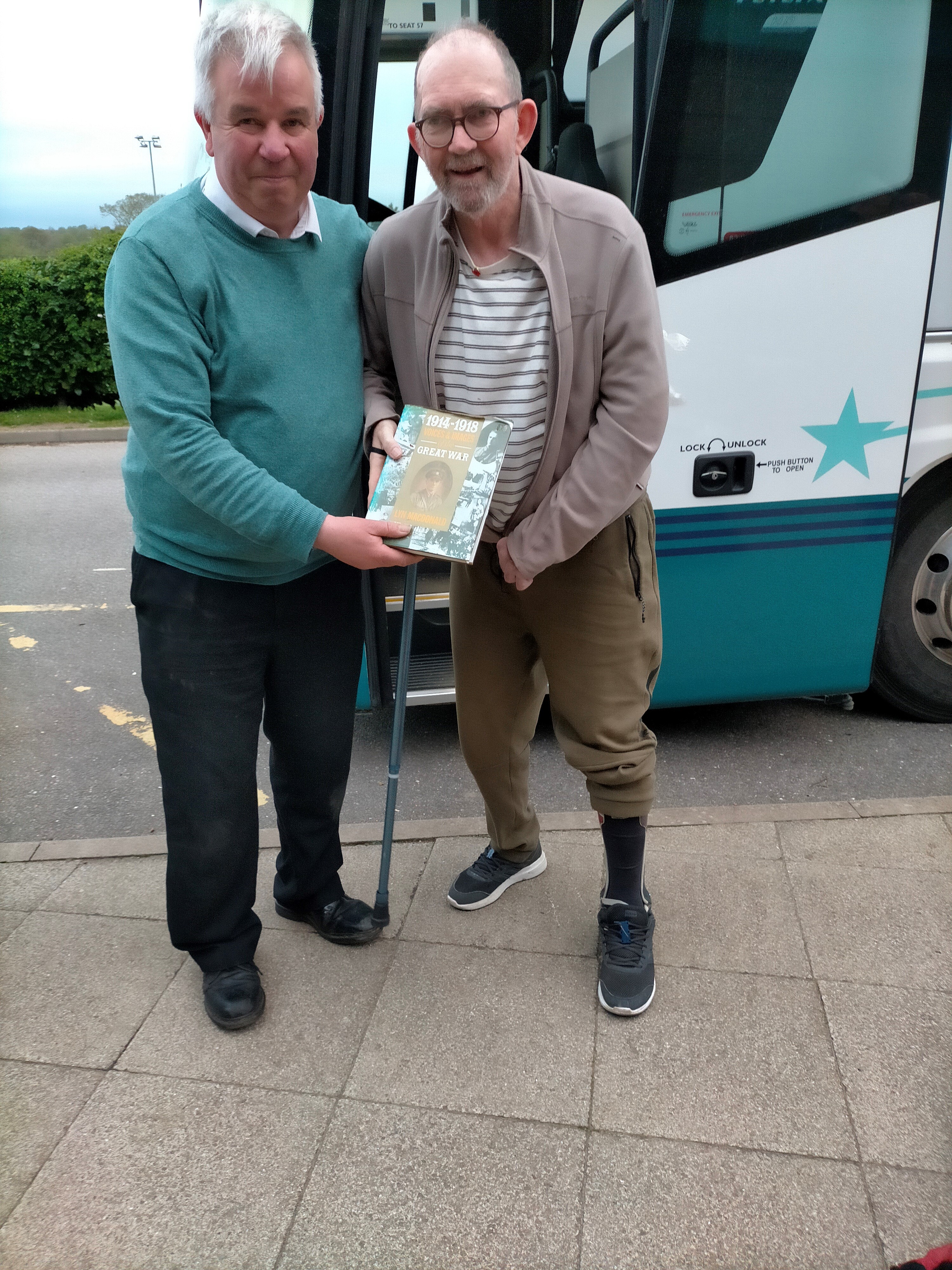
John, our driver from Edinburgh, in preparation for the tour, had read Lyn Macdonald's "1914-1918 Voices and Images of the Great War" - never a driver so conscientious and committed! He gifted the book to me at the end and I was as much moved by this gesture of his as I was by any other moment on the tour.
August 10th
Dear Mother,
I had a very good journey, a very nice fellow from Tonbridge School,
who is in a firm that supplies electric lights to railways, was the only other
occupant in the compartment, though otherwise the train was crowded.
On reaching Inverness, he took me to his hotel for a shave and wash-up.
In this hotel, I am now staying: it is clean and very moderate-a temperance affair; it gives you a high tea in the evening and no dinner. I never shaved so badly in my life, and got cut in five places. This is because the blades I bought in Boots just do not fit.
In spite of wounds, I went to the Camerons' place. At first they were rather brutal, thinking me to be a German spy, I suppose on account of my scarred face. They asked me a lot of questions to test my identity.Fortunately there was another Old Rugbeian applying for a similar job .(I had met him before this painful interview in the Medical Officer's place, where I was sent on arrival.)They turned me out of the room and sent for him, interviewing him separately. The result was that they suddenly turned friendly, and said that it was all right, BUT
i) I would have to wait until I was gazetted, and as there was a rush on the Regiment, I might be gazetted to some other regiment, and therefore they would not tell me what kit to get
ii) I could not get any kit in Inverness; Edinburgh was the nearest place.
They advised me to go back to Cambridge, but that would be fearfully expensive and cost about an extra £5. So I am going to write to the James' and ask them if they will put me up. I will let you know by wire where I am.
All love,
Jock.
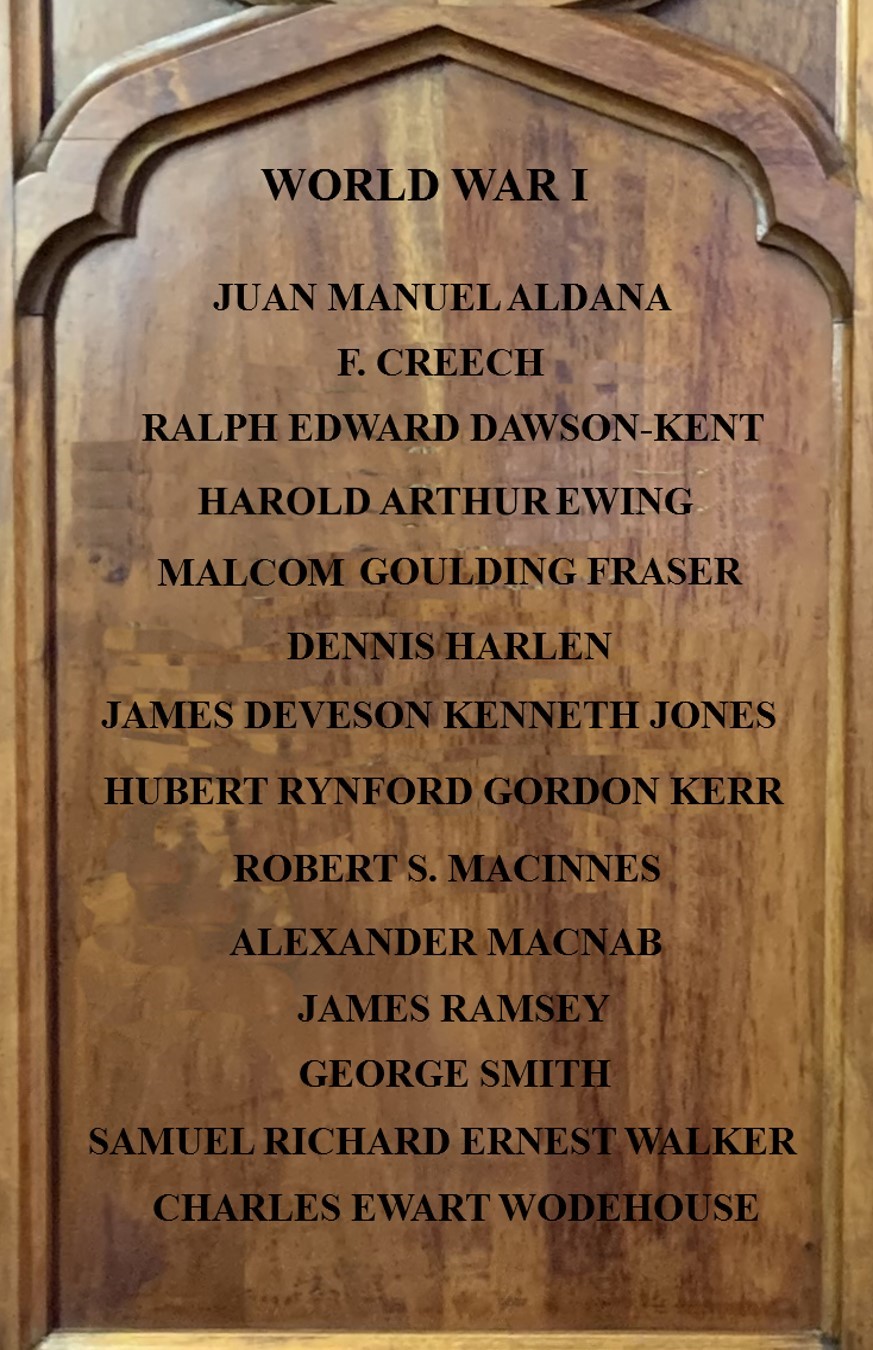
South Americans in WW1
This plaque (on right) hangs behind the altar in St. Andrew's Anglican Church (now Cathedral) in Santiago, Chile.
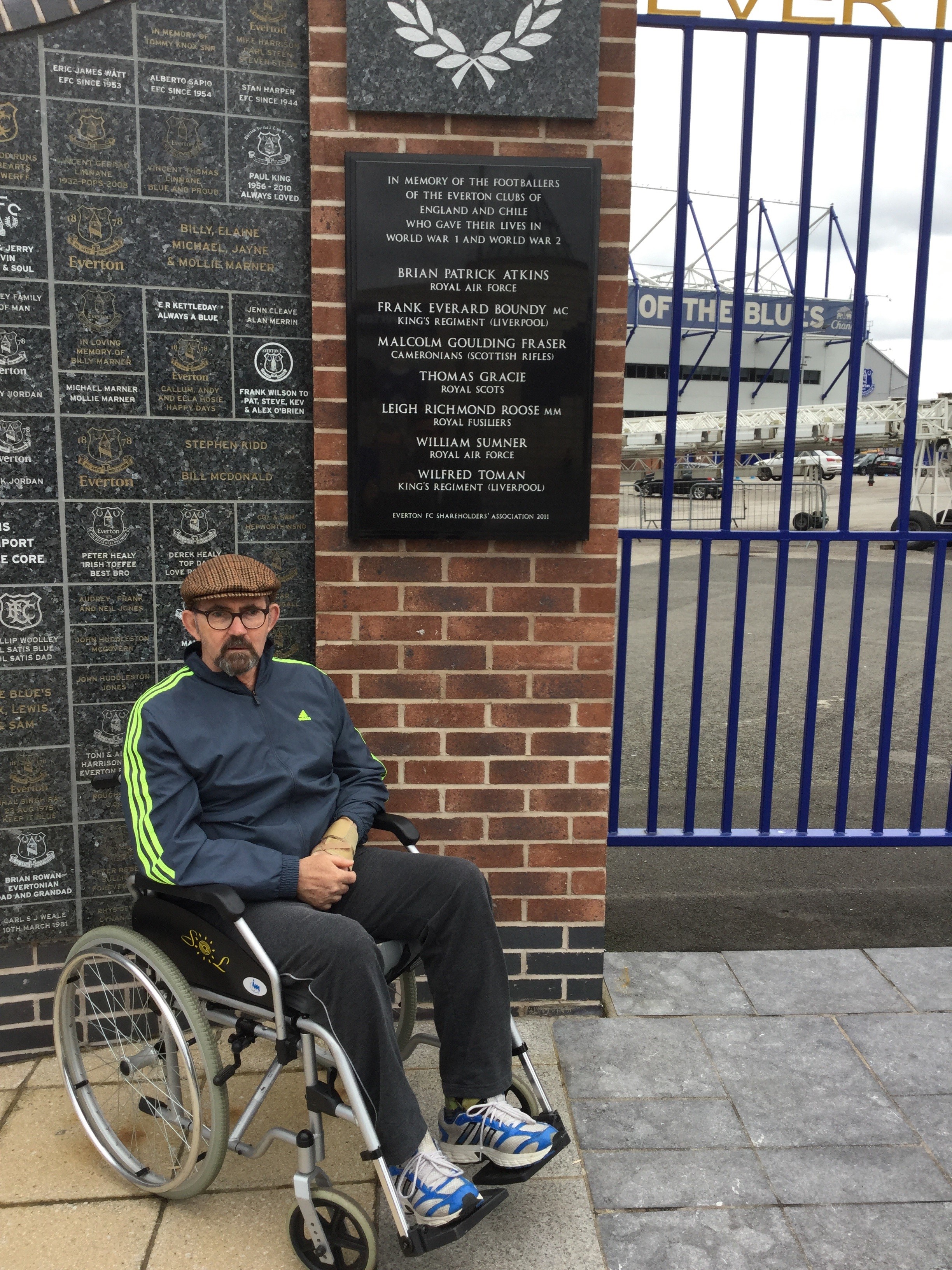
This plaque (on right) is from Goodison Park, the home ground of Everton football club. There is a copy of this plaque in the Estadio Sausalito in Viña del Mar, Chile, where in 1962 my father took me to watch England (Jimmy Greaves, Bobby Robson, Bobby Charlton, Gordon Banks etc.) play Brazil(Pelé, Vavá, Didi, Garrincha, Gilmar etc.). Everton Football Club in Chile was formed following a tour of South America in 1909 by Everton Football Club.
Obituaries of 2 of the people mentioned:
German-British relations in Chile in light of WW1
I have the original of a letter written in 1914 by my maternal great grandmother, Louisa Elena Wallace, from Valparaiso to her cousins in Scotland. I have transcribed below some excerpts from it which illustrate the impact of the war on the British community in Chile, particularly on their relationship with the large community of German descent also resident in Valparaiso, notably after the German victory at the battle of Coronel on 1 November 1914
December 24th 1914
My dear cousins,
I have not heard from you for more than 18 months. Before moving house some 15 months ago, I sent, besides my letter, a whole set of photos comprising about 23 views of the house and garden, both exteriors and interiors. After many months, I wrote asking you if you had not received them. Since this terrible war has been making so many homes destitute, you have very often been in my thoughts...
We have been in this house since September 1913. From Bertie's rooms upstairs we have a splendid view of the bay. We rush upstairs as soon as we hear saluting. Of course, often we are cheated and see a Chilian and not a British warship steaming in. The foreign ships and transports are only allowed 24 hrs in Port. Our ships allow no one on board - for fear of spies- they are in swarms here, in fact I have come to look upon them all as suspects, and not to be trusted. They are so mean and despicable.
I have always liked the Germans , and would never have believed them to be what they have proved themselves to be liars, brutes, thieves, in one word devils. My father must have had a wonderful insight for he always hated them, and if, on account of his German name Weber, was called a German he was furious, he never took the trouble to learn the language properly - I wonder how it was that he allowed me to have a German governess, but then she was a dear - and a great friend of my uncle's German wife.
I have never regretted knowing the language and now enjoy buying their newspapers (I always take care to tell the newsboy that I am English). They tell or write the most barefaced lies and insult our soldiers in the most ludicrous manner, calling them cowards, turntails, non-fighters, the reverse to all we know them to be, God bless them. Their own deeds are boomed, while ours are doomed, and I am sure that the majority are very much surprised that their navy did not eat their Xmas dinner in London. Here they seemed so sure about this boast being accomplished. Every German warship that came into the bay was received with the greatest enthusiasm by men women and children of their nation. The ladies went to the landing dock with flowers.
Among the photos I sent you (of course you may not have received them, or not acknowledged them), were several of Douglas in fancy dresses - for the last four years
he has taken part in Mrs.Powditch's 'Musical Plays'. Three years ago he had his first speaking part of importance & did splendidly, his clear voice carries very well, and filled the theatre satisfactorily. His solo song was rapturously applauded and encored - such a mite to be standing there singing "if the world were ruled by girls".
These plays are usually given at the end of each year - the money goes to local charities, but this year to our sailors - God Bless them - I have not yet heard how much the three performances cleared - unfortunately there are always many expenses in connection with things of this kind.
Last month a case with nearly 1000 articles of clothing for men, women and children were sent - to our ex-Consul's wife, Mrs Finn. Unfortunately only £40 in money, but then we only had two months to work in, and hope soon to have more garments ready - of course the business houses & private houses raised a substantial sum which was sent home, almost as soon as War was declared, besides a large collection for the Prince of Wales Fund - enfin, we are trying to do our little share here.
In spite of the exceedingly hard times in Chile, the "Oficinas Salitreras" (Nitrate) money is always found when wanted for gifts to our seamen who so frequently call in to Valparaiso.
As soon as it is known that a man-of-war is expected, the collection for cigarettes, chocolates etc. is made. Last week $5000 were contributed in two afternoons. Of course you must remember that it is always the same Firms, the same Families which are called upon for help for everything local or otherwise.
Hundreds of young Englishmen have left here to fight for their country, there are very very few left - a good many among them are intimate friends of ours. Yesterday Allan Rogers lunched with us. He leaves tomorrow with the Orcona. On Wednesday Bobbie King left. When he came to say goodbye, Douglas asked him to bring back "the tongue of the Kaiser" and when asked his reason, said:"I will throw it to the Germans over the balcony and say "There goes the tongue of a liar". We are surrounded with them - next door and the house beyond, and across the street on the same side. One threw flowers in the way of the officers as they came on shore. This was after the sinking of the Good Hope
and the Monmouth. They gave them banquets, concerts and everything they could, to show their pride in their noble navy. Von Spee is supposed to have begged them not to rejoice too much, as their turn might come soon. His words were prophetic but THEIR fate was in the hands of human beings, not fiends who allowed their antagonists to drown before their eyes.
This last month the feeling of the Chilian nation has become decidedly anti-German, very much strengthened by the contempt shown by the latter to the laws of neutrality. When the German Consul snd the Agent of Kosmos Cie. Were called on to interfere the answer was: "All Merchant Ships are under the Kaiser's command in time of war and we have no power to interfere"
I was terribly grieved to read of the death of Kenneth Mathieson at Ypres. Two weeks before,I received a letter from his mother in which she told me he was ordered to the front, such a hopeful, trustful letter, and then came this cable. Douglas, the younger boy was not allowed to go as he is needed in his father's office, she writes that 29 clerks have left Balfour Williamson & Co. between the London and Liverpool offices, but as that was in the beginning, in August, I fear Douglas will have persuaded his parents to let him go after all - it will not do for the heads of houses to keep back their boys, and they are very dear friends of mine. I am so proud of all our splendid young men's enthusiasm, relations, friends, strangers all flocking to serve their and our country.
God grant this cruel war will soon be over - it makes me feel ill when I think of all the precious life that has been sacrificed on account of one man & his confounded avarice, hypocrisy and envy, it is heartrending. My niece, Anita Wallace, married to Fred Prain, returned last month - they were paying a visit to the Old Country and had seen a great many old friends there, had had a glorious time, and were in the middle of a round of visiting and sight-seeing, when all was changed. They had to hurry back, had a most uncomfortable home journey, travelling at night without lights, were detained in Montevideo and Buenos Aires, and arrived here two months after they started for home. Their heavy luggage arrived about five days ago - fortunately they did not come round the Horn as they had intended, as their steamer struck a rock. She is in dock - nothing serious happened to her.
I wonder if you will get this long rigmarol - I hope so as I do not want you to think that I have forgotten you and yours. Please give my love to uncle, to cousins, at home and in the field. God bless and guard them and may 1915 bring you all peace and happiness.
Your affectionate,
Louisa E Wallace.