Family & Other Stories
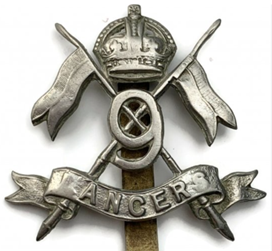
9th Queen's Royal Lancers in the First World War - Richard Sankey
Richard Sankey served in the 9th/12th Royal Lancers 1994-99
The regiment landed in France as part of the 2nd Cavalry Brigade in the 1st Cavalry Division in August 1914 for service on the Western Front.
When Britain declared war on Germany on 4th August 1914, the 9th Lancers was stationed at Tidworth, Wiltshire. Ordered to mobilise shortly afterwards, the Regiment landed at Boulogne on 15th August with strength of 27 officers, 523 other ranks and 611 horses.
When the Regiment returned to Tidworth from France in September 1919. The Commonwealth War Graves Commission recorded that between August 1914 and November 1918, 271 soldiers of the Regiment had died.
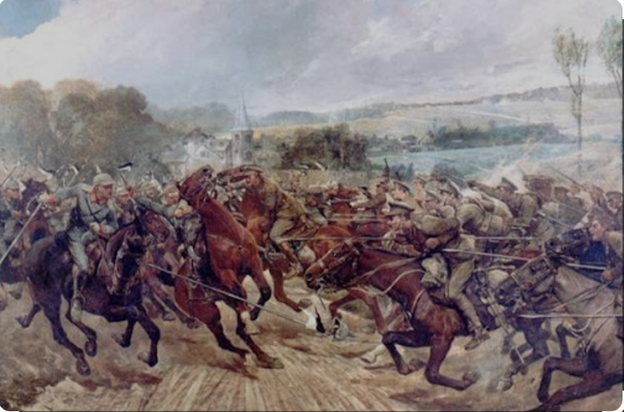
When the Regiment landed at Boulogne it was commanded by Lt. Col. Sir David Campbell, nicknamed 'Soarer' after the horse on which he had won the Grand National in 1896. The 9th Lancers took part in two charges early in the war, at Audregnies on 24th August and Moncel on 7th September 1914.
The charge by part of the Regiment on 7th September is noteworthy as it was the last ever 'lance on lance' cavalry charge of the British Army against a squadron of Prussian Dragoons. Campbell, who led the successful charge was shot, lanced and thrown from his horse. He told the medical officer attending him, who found him sprawled out in a patch of clover, that 'I've just had the best quarter of an hour I've ever had in my life'.
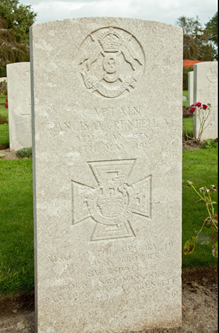
Captain Francis Octavius Grenfell VC 4th September 1880 - 24th May 1915
Francis Grenfell was one of fifteen children. He had a twin brother, Riversdale Grenfell, also in the 9th Lancers, who was killed in action in September 1914. Their maternal grandfather was Admiral John Pascoe Grenfell and other relatives included their uncle, Field Marshal Francis Grenfell, 1st Baron Grenfell. An older brother, Lieutenant Robert Septimus Grenfell, 21st (Empress of India's Lancers), was killed in a cavalry charge during the Battle of Omdurman in 1898.
A cousin, Lieutenant Claude George Grenfell (Thorneycroft's Mounted Infantry) was killed at Spion Kop during the Boer War and two other cousins Julian Grenfell, the poet, and his brother, Gerald William Grenfell, were killed in the First World War.
An Etonian who represented his school at cricket, Grenfell joined the army in 1900 and first served in the Second Boer War, in the King's Royal Rifle Corps, before joining the 9th Lancers.
On 24 August 1914 at Audregnies in Belgium, Captain Grenfell rode with the Regiment in a charge against a large body of unbroken German infantry. The casualties were very heavy and Grenfell was left as the senior officer. He was rallying part of the regiment behind a railway embankment when he was twice hit and severely wounded.
Despite his injuries, however, when asked for help in saving the guns by Major Ernest Alexander of the 119th Battery, Royal Field Artillery, he and some volunteers, under a hail of bullets, helped to manhandle and push the guns out of range of enemy fire for which he was awarded the Victoria Cross. The citation was gazetted on 16 September 1914 and read:
'For gallantry in action against unbroken infantry at Audregnies, Belgium, on 24th August 1914, and for gallant conduct in assisting to save the guns of the 119th Battery, Royal Field Artillery, near Doubon the same day'.
He was killed in action on 24 May 1915 and is buried in the Vlamertinghe Military Cemetery, 5km west of Ypres.